

GATE 2027 Notification Released: Complete Guide to Exam Dates, Registration, New Syllabus Changes & Major Updates

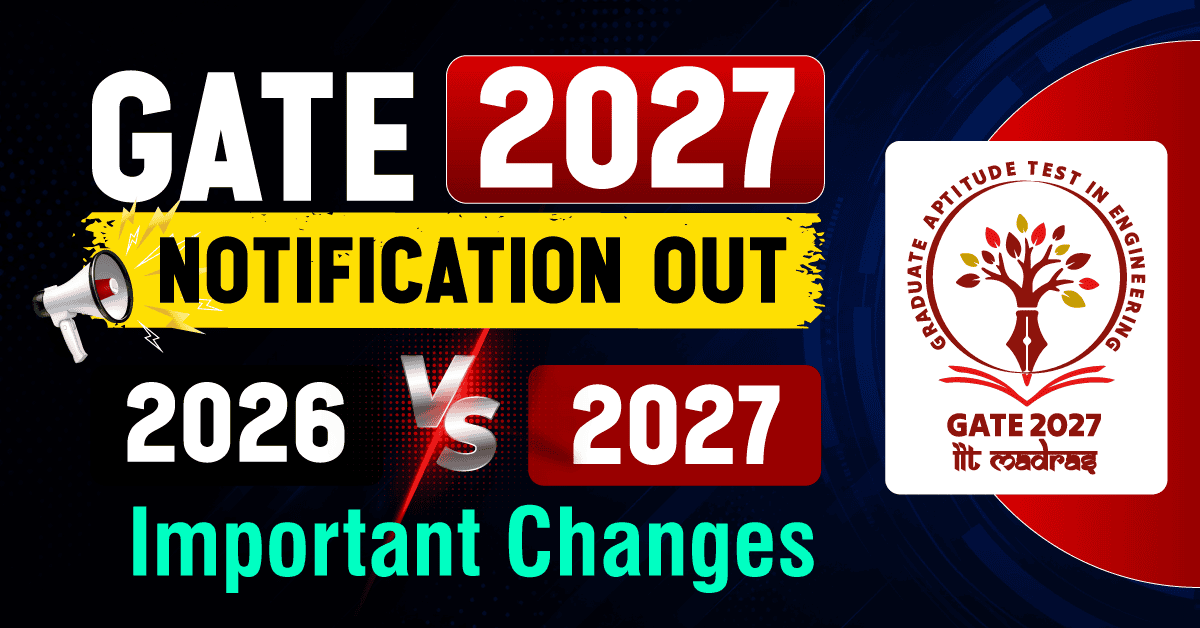
The Graduate Aptitude Test in Engineering (GATE) 2027 notification has officially been released by IIT Madras, bringing several important updates that every engineering aspirant should know before starting their preparation.
ACE COMMUNITY
Stay Updated.
GATE, ESE, PSU & State Exam notifications, plus updates on ACE Classroom, Online & Self-Paced courses — straight to your phone.
100%Free to join
AllExam updates
From registration dates and exam schedule to the introduction of a new Robotics paper, revised syllabi across multiple branches, updated two-paper combinations, and eligibility details, GATE 2027 introduces some of the most significant changes in recent years.
If you’re planning to appear for GATE 2027, here’s everything you need to know.
GATE 2027 Important Dates
| Event | Date |
|---|---|
| Online Registration Starts | 14 August 2026 |
| Last Date (Without Late Fee) | 21 September 2026 |
| Last Date (With Late Fee) | 30 September 2026 |
| Exam City Intimation | 04 January 2027 |
| Admit Card Release | To be announced |
| GATE 2027 Exam Dates | 06, 07, 13, 14, 20 & 21 February 2027 |
| Result Declaration | 19 March 2027 |
What is New in GATE 2027?
IIT Madras has introduced several notable changes for GATE 2027, including:
- New Robotics (RA) paper introduced
- Updated syllabus across multiple engineering disciplines
- Revised two-paper combinations
- Registration begins on 14 August 2026
- Six examination days scheduled in February 2027
- Improved syllabus aligned with current industry trends
These changes are aimed at making GATE more relevant to modern engineering education and industry requirements.
New Paper Introduced – Robotics (RA)
One of the biggest highlights of GATE 2027 is the addition of Robotics (RA) as a new test paper.
With this addition:
- Total number of GATE papers increases to 30
- Students interested in Robotics, Automation, Artificial Intelligence, Mechatronics, Embedded Systems and Smart Manufacturing now have a dedicated paper.
- This reflects the growing demand for robotics professionals across industries.
GATE 2027 Syllabus Changes
Unlike previous years, IIT Madras has revised the syllabus for several branches. Some branches have only minor modifications, while others have received major updates.
Let’s look at the branch-wise changes.
Mechanical Engineering (ME)
Mechanical Engineering has received the maximum number of updates.
Major Additions
Vibrations
- Two Degree of Freedom (2-DOF) systems added
- Damping estimation
- Transmissibility ratio
- Control Systems
- PID Controller
- Transfer Functions
Fluid Mechanics
- High-speed compressible flow
- Converging-diverging nozzles
- Velocity potential
Thermodynamics
- Explicit applications of First and Second Laws
- Entropy changes
- Open and closed systems
Manufacturing
- Additive Manufacturing introduced as a separate section
- Non-Traditional Machining
- Solid-state welding
- Non-Destructive Testing (NDT)
- Powder Metallurgy applications
Automation
New topics include:
- PLCs
- Hydraulic actuators
- Pneumatic actuators
- CNC Programming
Production Engineering
New additions:
- Six Sigma
- Productivity
- Quality Engineering
- Reliability Concepts
Several outdated topics like UTM testing and Heisler charts have been removed or modified.
Civil Engineering (CE)
Civil Engineering has undergone significant restructuring.
New Topics
- Transportation Planning
- Four-step Travel Demand Model
- GNSS Surveying
- Geodetic Surveying
- Ground Improvement Techniques
- River Training Structures
- Tertiary Water Treatment
- Landfill Design
- Construction Equipment
- Construction Contracts
- Digital Photogrammetry
Major Changes
- Construction Materials & Management is now a separate section.
- Prestressed Concrete has been removed.
- Design of Isolated Footings has been added.
- Plate Girders and Trusses removed.
- Environmental Engineering expanded with advanced treatment processes.
Overall, Civil Engineering now places greater emphasis on practical infrastructure and modern construction technologies.
Computer Science & Information Technology (CS)
The Computer Science syllabus has undergone selective revisions.
Digital Logic
New additions:
- Karnaugh Maps
- Quine-McCluskey Method
- Circuit Design Techniques
Computer Organization
Added topics:
- ALU Design
- Hardwired Control Unit
- Microprogrammed Control
- Memory Interfacing
- Cache Memory Mapping
Computer Networks
Several topics have been streamlined.
Reduced emphasis on:
- ARP
- DHCP
- ICMP
- Routing Protocols
- TCP Congestion Control
- Socket Programming
Greater focus on:
- DNS
- HTTP
- Network Layering
- Ethernet
- Performance Metrics
Most remaining sections—including Algorithms, Operating Systems, Databases, Compiler Design, and Theory of Computation—remain unchanged.
Electronics & Communication Engineering (EC)
The EC syllabus has received moderate updates.
Newly Added Topics
- FIR Filter Design
- IIR Filter Design
- MOSFET Scaling
- Miller Compensation
- Phase Margin
- PID Controller
- Source Coding
- Correlation Analysis
- Regression Analysis
Core Digital Electronics and Electromagnetics remain unchanged.
Data Science & Artificial Intelligence (DA)
Good news for DA aspirants!
There are no syllabus changes.
The syllabus has simply been reorganized into seven clearly defined sections:
- Probability & Statistics
- Linear Algebra
- Calculus & Optimization
- Programming, Data Structures & Algorithms
- Database Management
- Machine Learning
- Artificial Intelligence
No new topics have been added or removed.
Electrical Engineering (EE)
Electrical Engineering remains completely unchanged.
All ten sections continue exactly as in GATE 2026, including:
- Engineering Mathematics
- Electric Circuits
- Electrical Machines
- Power Systems
- Signals & Systems
- Control Systems
- Measurements
- Analog Electronics
- Digital Electronics
- Power Electronics
This means EE aspirants can continue their preparation using existing study materials.
GATE 2027 Exam Pattern
There are no changes in the examination pattern.
- Mode: Computer Based Test (CBT)
- Duration: 3 Hours
- Total Marks: 100
- General Aptitude: 15 Marks
- Subject Questions: 85 Marks
- Question Types: MCQs, MSQs and NAT Questions
Two-Paper Combination
Candidates may appear for:
- One Paper
- Two Papers (only from the officially permitted combinations)
Students should carefully verify the official list of eligible two-paper combinations before submitting the application.
Eligibility
Candidates who are:
- Final Year B.E./B.Tech
- B.Arch
- Integrated M.Tech
- M.Sc
- MCA
- Graduates
- Postgraduates
are eligible to apply as per the official GATE 2027 guidelines.
Why Should You Write GATE 2027?
A good GATE score opens the door to:
- M.Tech admissions in IITs, NITs, IIITs and IISc
- PSU recruitment
- Ph.D. admissions
- Research fellowships
- Government organizations
- Higher education opportunities abroad
- Scholarships and financial assistance
Preparation Tips for GATE 2027
With the revised syllabus, aspirants should:
- Download the latest official syllabus before starting preparation.
- Compare GATE 2026 and GATE 2027 topics.
- Focus on newly added concepts.
- Revise removed topics only if necessary.
- Solve previous years’ question papers.
- Attempt full-length mock tests regularly.
- Follow a structured study plan aligned with the updated syllabus.
Final Thoughts
GATE 2027 brings one of the most comprehensive updates in recent years. The introduction of the Robotics (RA) paper, significant syllabus revisions in Mechanical, Civil, Computer Science, and Electronics, and the continuation of a stable exam pattern make it essential for aspirants to prepare using the latest syllabus.
If you’re aiming for a top rank in GATE 2027, start your preparation early, stay updated with the latest changes, and follow a disciplined study strategy. With the right guidance and consistent practice, you can maximize your chances of securing admission to premier institutes and achieving your career goals.